
DIY Garage Door Checks vs. Professional Service: How Often Should You Do Each? 3 Key Differences
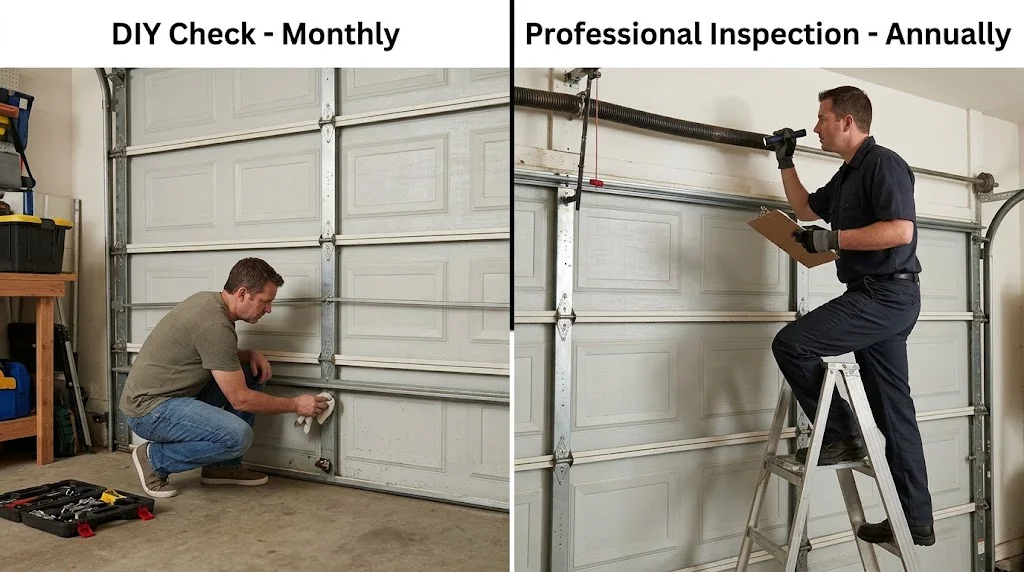
The split comes down to three things: the tools and skill a task actually requires, the safety risk involved, and whether paying for professional service saves more time and money than it costs. Simple visual and functional checks are reasonable to do monthly on your own. Anything touching springs, cables, or the opener’s internal calibration should go to a trained technician, typically once a year.
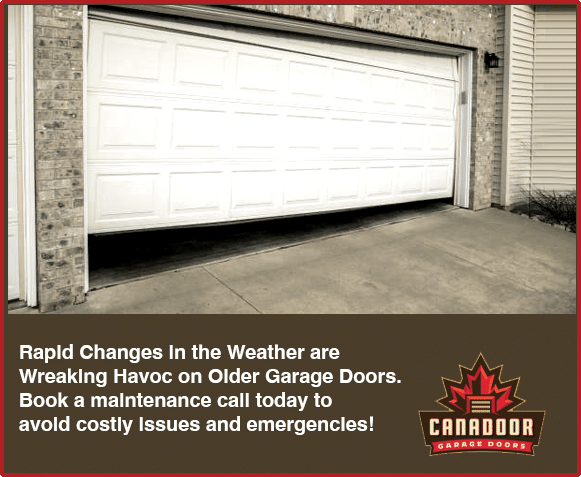
Homeowners often assume “DIY” and “professional” are a matter of confidence or willingness to try, but the more useful way to think about it is task by task. Some parts of garage door care are genuinely low-risk and low-skill, closer to changing a smoke detector battery than a repair. Others carry real injury risk regardless of how careful or capable someone is, because the danger comes from the physics involved rather than from a lack of skill. Knowing which is which prevents both unnecessary garage door repair bills from over-hiring and real injury from under-hiring.
Key Takeaways
- The line isn’t about confidence; it’s about the specific tools, skill, and risk each task actually involves.
- Visual checks, lubrication, and basic balance tests are reasonable DIY tasks for most homeowners.
- Springs, cables, and opener force calibration should always go to a trained technician.
- Getting this split wrong in either direction, over-hiring or under-hiring, costs more than getting it right.
Task-by-Task: Safe for DIY or Not
| Task | Safe for DIY? | Recommended Frequency |
| Visual inspection of springs, cables, hinges | Yes | Monthly |
| Lubrication of hinges, rollers, tracks | Yes | Every 6 months |
| Manual balance test | Yes, with care | Monthly |
| Spring tensioning or replacement | No | As needed, professional only |
| Opener force and safety reverse calibration | No | Annually, professional only |
Read more about the manufacturer-recommended schedule these tasks are drawn from in How Often Should You Get a Professional Garage Door Inspection? 3 Manufacturer Guidelines to Follow
1. Tools and Skill: What Each Side Actually Requires
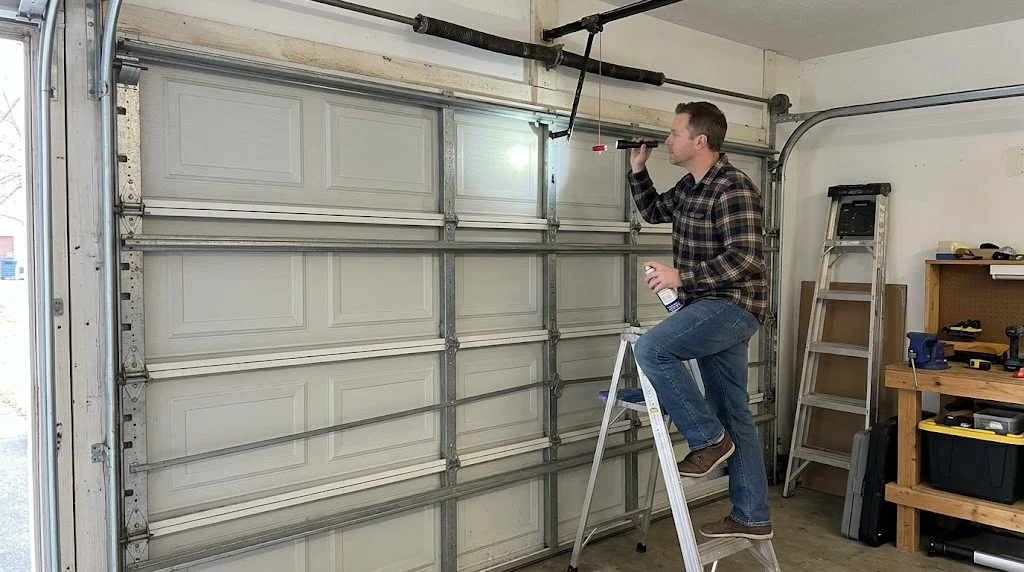
A basic residential garage door check requires almost nothing beyond a flashlight and a step stool, while professional work requires specialized, purpose-built tools.
What Tools and Skills DIY Garage Door Checks Actually Require
The homeowner side of this list is intentionally simple. A visual inspection needs nothing more than good lighting and a few minutes of attention. A balance test just requires disconnecting the opener and lifting the door by hand, then watching how it behaves without any powered assistance.
- A flashlight or good lighting for visual inspection
- A step stool for reaching hinges and upper rollers
- A basic spray lubricant for hinges, rollers, and tracks
- No specialized tools required for any of the monthly checks
Professional work is a different category entirely, requiring winding bars for spring tension, torque tools calibrated for opener hardware, and training most homeowners simply don’t have and shouldn’t need to acquire for occasional use. The gap here isn’t really about willingness to learn; it’s that the tools themselves are specialized enough that owning them for a once-a-year task rarely makes sense.
Call a pro if: a task calls for a tool you don’t already own specifically for garage doors, that’s usually a sign it belongs on the professional side.
For the broader signs that it’s time for service in general, read How Often Should Garage Doors Be Serviced? 5 Signs It’s Time for a Tune-Up.
2. Safety Risk: Where DIY Crosses a Real Line
Most of the DIY side of this list carries minimal risk, but a small number of tasks cross into genuinely dangerous territory regardless of skill or care.
Why Certain Garage Door Tasks Carry Real Safety Risk for DIYers
Springs store enormous tension, often equivalent to hundreds of pounds of force, and a mistake while adjusting or replacing one can cause serious injury. This isn’t a matter of confidence or careful handling; it’s a matter of the physics involved being unforgiving of error, in the same way that no amount of caution makes it safe to stand under a suspended weight held by a single failing point.
- Spring tensioning or replacement, due to stored energy under high tension
- Cable work, since frayed or snapped cables under load can cause injury
- Opener force calibration, where incorrect settings can create a crushing hazard
- Any repair requiring the door to be propped open under partial spring tension
Call a pro if: a task involves springs, cables, or opener force settings, full stop, regardless of how confident you feel. A closer look at what happens if these risks are ignored entirely is covered in What Happens If You Skip Garage Door Maintenance? 4 Costly Problems to Expect.
This Old House’s guide to replacing a garage door spring is explicit that while the steps can be described, the process carries genuine risk and many homeowners reasonably opt to call a professional rather than attempt it themselves.
3. Cost and Time: Where Paying for a Pro Actually Saves You Both
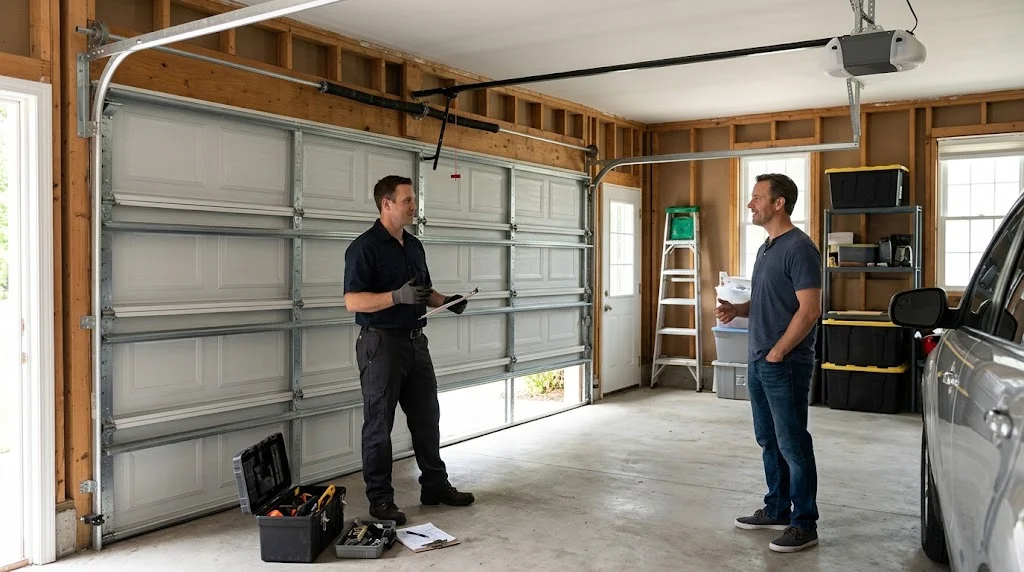
This is the least intuitive of the three differences, since DIY often seems like the cheaper option on the surface. The reality is more nuanced, because the true cost of a DIY attempt includes not just parts, but the risk of a failed attempt, the value of the time spent, and any downstream damage caused by getting it wrong.
How Professional Service Compares to DIY on Cost and Time for a Commercial Garage Door
For a lightly used residential door, the calculation is usually straightforward. For a heavily cycled commercial garage door, the math shifts further toward professional service, since downtime and liability both scale with how often the door is used, and a single failed cycle on a busy commercial entrance can disrupt operations far more than it would for an occasional residential user.
- A DIY mistake on a covered repair can void warranty coverage entirely
- Hiring a specialist the first time is often cheaper than a DIY attempt followed by a professional fix
- Professional visits typically bundle multiple checks into one trip, saving repeated homeowner time
- A licensed technician carries insurance that protects you if something goes wrong during the repair
Call a pro if: you’re weighing whether a repair is worth attempting yourself purely to save money, since a failed DIY attempt on a covered component often costs more in the end than hiring a professional from the start. Angi’s guide on who to hire for garage door repair or installation notes that using an unqualified handyperson instead of a specialist can void a warranty and often ends up costing about the same once specialized tools and lost time are factored in.
The Split Isn’t About Confidence, It’s About the Task
Getting this split right isn’t about how handy you are, it’s about matching the actual risk and complexity of each task to who’s doing it. Simple monthly checks are well within reach for most homeowners, while anything involving springs, cables, or opener calibration belongs with a trained technician every time. At Canadoor Garage Doors, our annual visits cover the professional side of this list completely, so homeowners only need to manage the simple monthly checks in between. Contact us or give us a call to get your door on that schedule.
Frequently Asked Questions
What's the actual cost difference between DIY and professional service for routine checks?
Routine monthly checks cost nothing beyond a few minutes of time, since they require no special tools. The cost difference only appears with the annual professional visit, which is a small, predictable expense compared to emergency repair costs later, especially once a neglected issue has caused secondary damage.
Can a handyperson do the professional-side tasks instead of a specialist?
It's generally not recommended. Garage door specialists carry specific tools, training, and insurance for spring and opener work that a general handyperson typically doesn't have, and using one may also affect warranty coverage if something goes wrong.
How do I know if a specific task is DIY-safe or not?
As a general rule, anything involving visual inspection, lubrication, or manually testing balance is DIY-safe. Anything involving springs, cables, or opener force settings should always go to a professional, regardless of how simple the task might look.
What happens if I attempt a professional-only task and it goes wrong?
Beyond the immediate injury risk, a failed DIY attempt on a covered component can void warranty coverage and often costs more to fix afterward than it would have cost to hire a professional from the start, since the failed attempt can cause additional damage.
Do professional visits include the DIY checks too, or just the harder tasks?
A thorough professional visit typically includes everything on this list in one trip, both the simple checks and the higher-risk tasks, which is part of why an annual visit is efficient compared to piecing things together yourself over the course of a year.
Is DIY lubrication actually effective, or does it need to be done by a professional?
DIY lubrication with a basic garage door spray lubricant is genuinely effective and one of the easiest maintenance tasks homeowners can do well on their own, provided it's applied to the right components on a regular schedule.
How often should I personally check my garage door versus scheduling a professional visit?
A monthly self-check alongside an annual professional visit covers the large majority of cases. Heavier use or specific symptoms, like new noise or hesitation, may warrant more frequent professional attention than the standard interval.
Does insurance cover injuries from a DIY garage door repair gone wrong?
This depends entirely on your specific home insurance policy, so it's worth checking directly rather than assuming coverage either way, particularly before attempting anything involving springs or cables where injury risk is highest.
What's the biggest mistake homeowners make when deciding between DIY and professional service?
Treating the decision as a single choice rather than a task-by-task one. Some tasks are genuinely fine to DIY while others in the same maintenance routine are not, and lumping them together leads to either unnecessary spending or unnecessary risk.