
How Often Should Garage Door Rollers Be Replaced? 7 Signs Yours Are Worn Out
Most garage door rollers need replacing every 10 to 15 years, but the material decides almost everything. Nylon rollers with sealed ball bearings last 10 to 15 years or roughly 20,000 cycles. Steel rollers with unsealed bearings last 5 to 8 years. Builder grade plastic rollers with no bearings at all often fail in 2 to 5 years. A standard four section door runs on about ten rollers, and they wear as a set, so replacing one and leaving nine is a short term fix. In an Ontario garage, road salt and freeze-thaw shorten every one of those numbers. Rollers are also among the least expensive garage door repair jobs there is, which is worth knowing because letting them go is what turns a cheap fix into garage door spring and cable repair once the door starts binding and loading the rest of the hardware.
Key takeaways
- Cycles matter more than years. A door opened eight times a day burns through roller life roughly four times faster than one opened twice a day.
- Replace them as a set, not one at a time. They have all done the same work, so a single new roller among nine worn ones just moves the noise along the track.
- Noise is the first symptom, every time. Grinding, squealing, or a rumbling that has changed character is the earliest reliable warning.
- Nylon with sealed bearings is worth the upgrade. It roughly doubles the service life of steel, runs considerably quieter, and it is the single cheapest way to make an old door feel new.
- Worn rollers damage other things. They chew the track, load the opener, and are one of the most common precursors to a door coming off its track entirely.
- Bottom rollers are not a DIY job. The bottom bracket is attached to a lift cable under full spring tension, and that is where the serious injuries in this trade happen.
Roller types and how long each last
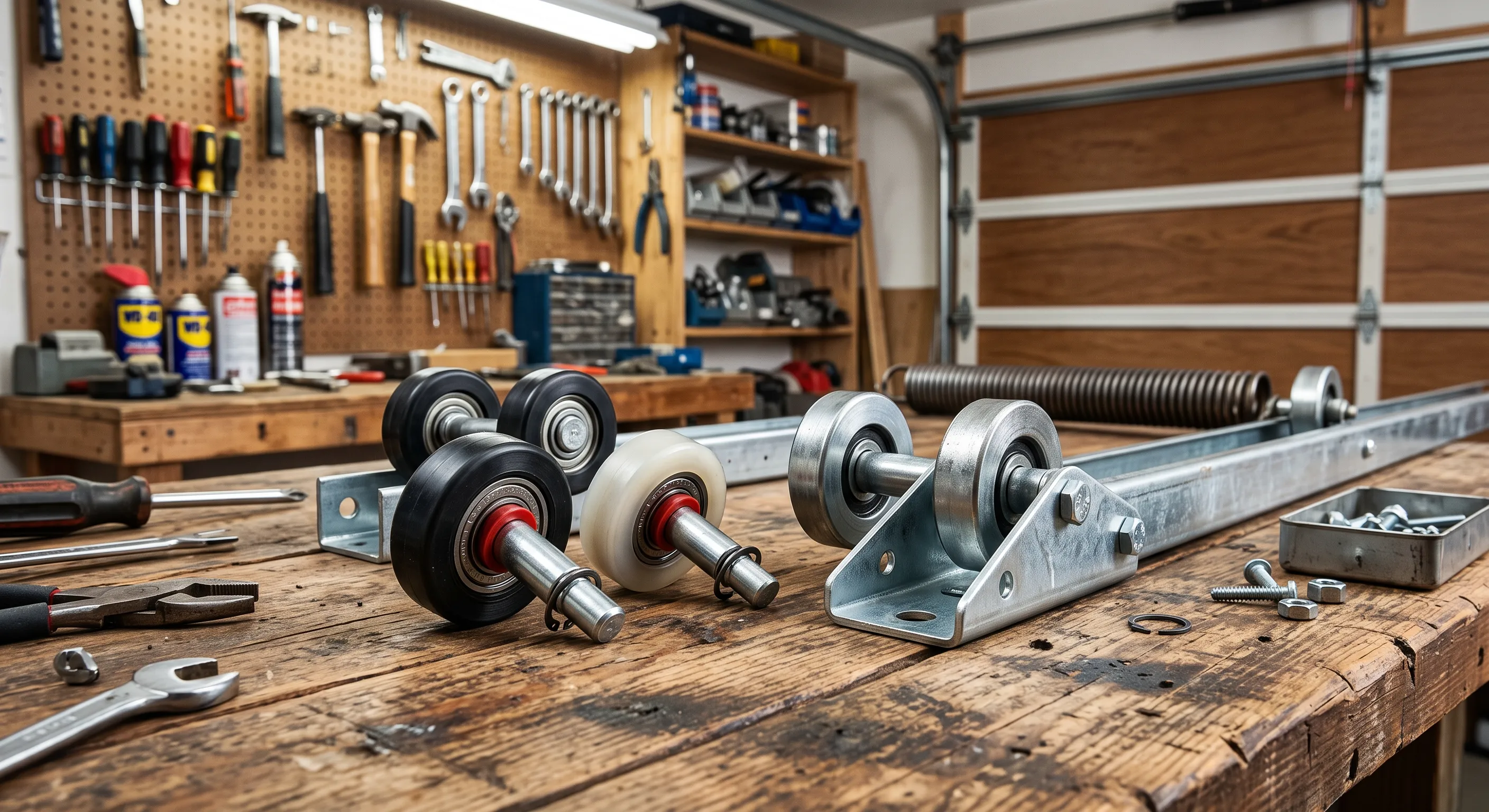
| Roller type | Typical lifespan | Cycles | Noise | Notes |
|---|---|---|---|---|
| Nylon with sealed ball bearings | 10 to 15 years | ~20,000 | Quietest | Best value on a door you plan to keep |
| Nylon with unsealed bearings | 8 to 12 years | ~15,000 | Quiet at first | Bearings pack with grit over time |
| Steel with ball bearings | 5 to 8 years | ~10,000 | Loud, metallic | Common factory fitment |
| Plastic, no bearings | 2 to 5 years | ~5,000 | Loud, then grinding | Builder grade, usually the first thing to fail |
1. The noise has changed
A new grinding, squealing, or rumbling sound is the first sign of roller wear, and it is the one you will notice months before anything else. Rollers are the only part of the door in constant rolling contact with metal, so they announce their condition audibly.
Listen for what kind of noise it is. A dry squeal usually means the bearing has lost its lubrication and can often be improved with proper lubrication. A gritty grinding means the bearing surfaces are already damaged and lubrication will only postpone the replacement. A rumble that rises and falls as the door travels usually means one or two specific rollers rather than the whole set.
Run the door with the opener disconnected if you want to isolate it. Hand operation removes the motor noise and makes the source obvious.
Call a pro if: the grinding persists after lubrication, or if you can hear a distinct change from one specific point in the door’s travel. Background on decoding door sounds: what garage door squeaks, grinding, and banging usually mean.
Why are my garage door rollers making a grinding noise?
Because the bearing inside the roller has worn, lost its grease, or packed with dirt, so the roller is no longer spinning freely on its stem. Once the bearing surfaces are scored, the noise will not go away with lubrication because the damage is mechanical rather than frictional. Catching it at the squeal stage rather than the grind stage is the whole reason the monthly listening check exists in How Often Should You Get Your Garage Door Serviced? An 8-Point Ontario Maintenance Schedule.
2. The door jerks or shudders as it moves
A door that hesitates, jerks, or shudders partway through its travel usually has one or more rollers that have stopped turning smoothly. The door is being dragged rather than rolled through that part of the track.
Watch a full cycle from inside the garage. A door with a healthy set of rollers moves at a constant speed with no visible hitch. If it catches at the same point every time, that is a mechanical problem at that point: a worn roller, a bent track section, or a loose hinge letting a section shift.
The distinction matters because the fixes are different. A roller problem follows the roller. A track problem stays in one place on the wall.
Call a pro if: the hitch repeats at a fixed point, or if the door has started to shudder under load. Related: how to fix a bent garage door track and how to fix a jammed garage door.
Why does my garage door shudder when it opens?
Most often because a roller has seized or gone out of round and is skidding through part of the track instead of rolling. Loose hinges and a slightly bent track produce the same symptom, which is why the diagnosis is about whether the hitch travels with the door or stays in one spot on the wall. A door that shudders is also working the opener harder than it should, and that shows up later as garage door openers failing early.
3. You can see wobble or play in the roller
Grab nothing, just look. A roller that visibly rocks, tilts, or has play where its stem enters the hinge is worn out. Healthy rollers sit square in the track and turn without any side to side movement.
Check this with the door closed and the opener disconnected so nothing can move unexpectedly. Look along the track at each roller in turn. You are looking for a roller that is not sitting flush in the track channel, a stem that has worn oval where it passes through the hinge, or a roller riding on the edge of the track rather than in the middle of it.
Play in the stem is often the real problem rather than the wheel itself. A worn hinge lets the roller cant over, and once it is canted it wears the track edge.
Call a pro if: you find play at more than one or two positions, or if the hinge itself is worn rather than the roller. Hinge and roller replacement is done together for this reason.
What does a worn garage door roller look like?
Canted in the track instead of square, often with a visibly oval hole where the stem passes through the hinge, and frequently with a shiny wear band on one side of the wheel where it has been riding the track edge. On steel rollers you will sometimes see the bearing balls or a gap where retained grease has escaped. None of it requires tools to spot, which is why this belongs in a monthly visual pass.
4. Flat spots, cracks, or chunks missing from the tread
Run your eye over the wheel surface. Flat spots, cracking, or missing pieces of nylon mean that roller is finished, regardless of its age. This is the most unambiguous sign on the list, because there is nothing to interpret.
Nylon rollers fail by cracking and chipping, usually starting at the edge of the tread. Plastic rollers without bearings fail by developing flat spots where they have skidded instead of rolled. Steel rollers do not crack, but they develop a worn lip and eventually the bearing cage lets go.
A door with one flat spotted roller thumps once per revolution of that wheel, which is a distinctive sound once you know to listen for it.
Call a pro if: any roller shows cracking or a missing chunk. A roller that fails completely mid travel can jump the track, and that turns a modest job into a much larger one.
Can you replace just one garage door roller?
Physically yes, practically no. All ten have done identical work over the same number of cycles, so the others are close behind. Replacing one leaves you paying a service call for each subsequent failure and living with a door that never quite quietens down. The exception is a single roller that failed early from a specific defect, which a technician can identify by how it differs from its neighbours. For what individual parts are worth replacing, see the most expensive parts of a garage door.
5. The rollers are sliding rather than rolling
Mark one roller with a dab of chalk or a piece of tape, run the door, and see whether the mark rotates. A roller that is not turning is being dragged through the track. This is the check almost nobody thinks to do, and it finds seized bearings that look fine standing still.
A sliding roller does three kinds of damage at once. It scores the track, it puts a large load on the opener, and it drags the door’s alignment off over time. It is also the most common reason a door starts binding at the curve in the track where the vertical section meets the horizontal.
One frequent cause is worth naming: lubricant applied to the track instead of to the rollers and hinges. Grease in the track collects grit and turns the channel into an abrasive paste, which is exactly the opposite of the intended effect.
Call a pro if: any roller fails the rotation test. A seized roller does not recover.
Why is my garage door binding at the curve in the track?
Because that is where the door changes direction and where any roller that is not turning freely has to be forced. A binding door meets more resistance, and modern openers read resistance as an obstruction, which is why worn rollers often show up first as a door that reverses partway down for no visible reason. That connection is covered in How Often Should You Test Your Garage Door’s Auto-Reverse? 6 Safety Checks to Do Every Month.
6. Rust, packed dirt, or a bearing full of grit
Look for rust bloom on steel rollers and for bearings packed solid with dust, sand, or salt residue. In an Ontario garage this is the single biggest reason rollers fail early. Contamination kills bearings faster than mileage does.
Road salt is the specific culprit. Snow melts off the vehicle, the brine runs across the floor, and the bottom rollers sit in it. Unsealed bearings wick it straight in. Add the freeze-thaw cycle and you get corrosion inside a component that was designed on the assumption of a dry environment.
Sealed nylon rollers are largely immune to this, which is the practical argument for upgrading rather than replacing like for like on any door that sees a winter vehicle.
Call a pro if: you see rust inside the bearing rather than just surface rust on the stem. Surface rust is cosmetic, bearing rust is terminal.
How does road salt affect garage door rollers in Ontario?
Brine carried in on a vehicle runs to the lowest point of the garage floor, which is usually right at the bottom of the door, and unsealed bearings absorb it. The corrosion that follows destroys the bearing from the inside, which is why steel rollers in an Ontario garage often fall short of even their 5 to 8 year range. Rinsing the bottom section each spring and keeping the lubrication schedule are the two things that actually help, and the cold weather timing is set out in How Often Should You Lubricate a Garage Door in Winter? A Seasonal Ontario Guide.
7. The door has come off its track, or the track is damaged
A door that has jumped its track, or a track with a visibly worn or flared edge, is the end stage of roller wear rather than a separate problem. By the time you are here, the rollers stopped being the only thing that needs replacing.
Stop using the door. A door partially off its track is held up by whatever is left of its hardware, and cycling it makes the situation worse. Disconnect the opener and leave it closed. That last step matters more than it sounds, because garage door openers will keep pulling against a door that has nowhere to go, and a few cycles in that state can bend a section or strip the drive gear.
Track damage from worn rollers shows as a flared or grooved edge where a canted roller has been riding. If the groove is deep, the track section is replaced along with the rollers, because a new roller in a worn channel will not run true. Where the door itself has creased or buckled against the misaligned track, garage door panel repair and replacement becomes part of the job rather than an afterthought.
Call a pro if: always, without exception. This is the one item on the list with no homeowner component at all. See garage door roller off track repair and, if the door itself took damage, garage door panel repair and replacement.
Can a garage door come off track from worn rollers alone?
Yes, and it is one of the more common ways it happens. A roller that has cracked or seized rides the edge of the track instead of the channel, gradually flares that edge, and eventually there is not enough lip left to hold it. The other frequent causes are a broken cable and an impact from a vehicle. Cable failure is covered in why garage door cables break.
What you can do yourself, and what needs a technician
| Task | DIY safe | Call a technician | Why |
| Visual roller inspection | Yes | No | Observation only, no contact needed |
| Chalk mark rotation test | Yes | No | Simple, and it finds seized bearings nothing else catches |
| Lubricating rollers and hinges | Yes | No | Basic, provided the lubricant goes on the bearings and not in the track |
| Replacing a middle or top roller | Sometimes | If you are unsure at all | Requires opening a hinge, and a mistake lets a section shift |
| Replacing a bottom roller | Never | Always | The bottom bracket is attached to a cable under full spring tension |
| Replacing the full set | No | Yes | Done properly it includes hinge inspection and track alignment |
| Straightening or replacing track | No | Yes | Track alignment determines whether new rollers run true |
| Anything on a door that is off track | Never | Always | The door is unsupported and under load |
If someone has offered to swap your rollers as a quick side job, the distinction in garage door technician versus handyman service is worth reading first. Certification standards for technicians in Canada come from the Canadian Door Institute, and the technical standards for door hardware come from the Door and Access Systems Manufacturers Association.
When replacement is worth it, and when it is not

Rollers are one of the best value repairs on a garage door. They are inexpensive relative to almost every other component, the labour is short, and a full set of sealed nylon rollers transforms how an older door sounds and runs. On a door that is otherwise sound, this is close to a default yes.
The calculation changes when the door itself is near the end. If the sections are rusting through, the springs are due, and the opener is fifteen years old, spending on rollers is putting good parts into a door that is being replaced within a couple of years. That conversation is laid out in when to fix versus when to replace your garage door and how long a garage door should last in Ontario.
Canadoor Garage Doors carries sealed nylon rollers as standard and replaces them as a set with a hinge and track check included, across.
Book a roller replacement or a full inspection, or request a free quote if the noise has already turned into a door that will not run properly. Same day garage door repair is available for doors that have come off their track.
Related reading: what makes a garage door quiet, how to quiet down a noisy garage door, and why garage door maintenance is essential.
Frequently asked questions
2. Are nylon rollers really quieter, or is that marketing?
Genuinely quieter, and it is one of the more noticeable improvements you can make to an older door. Nylon does not transmit vibration into the track the way steel does, and sealed bearings stay smooth for far longer. On a door with an attached bedroom above the garage, this is usually the fix people are actually looking for. See what makes a garage door quiet.
3. My door is only six years old. Can the rollers already be worn?
Easily, if they are steel or plastic and the door gets heavy use. Six years at eight cycles a day is around 17,000 cycles, which is beyond what a steel roller is rated for. Age on its own tells you very little. Count the cycles instead.
4. Will replacing the rollers fix my noisy door completely?
Usually a large part of it, but not always all of it. Rollers are the most common source, and after that come dry hinges, a loose opener rail, and vibration transmitted through the mounting. If the noise persists after new rollers, the next suspects are the opener mount and the drive. See how to stop a noisy garage door opener from causing vibration.
5. How much does roller replacement cost?
A full set of rollers with labour sits at the lower end of garage door repairs, generally in the low hundreds of dollars depending on the door size and the roller specification. It is one of the few jobs where the upgrade to sealed nylon costs very little more than a like for like replacement, which is why it is usually worth doing. If you are budgeting for the year rather than reacting to a failure, CMHC publishes guidance on setting aside a maintenance reserve for a home, and small wear items like rollers are exactly what that reserve is for.
6. Can I lubricate my way out of replacing them?
For a while, if the bearing is only dry. Not at all, if the bearing surfaces are already scored. The test is what happens after a proper lubrication: a squeal that goes away was friction, a grind that persists is damage. Lubricating a failed bearing buys weeks, not years. Worth knowing before you start: an attached garage is part of your home's building envelope, and Ontario sets out which work on it needs a permit or a licensed trade, which is a useful line to know when you are deciding how far to take a repair yourself.
7. Should the rollers be replaced when the springs are done?
It is often the sensible time to do both, because the technician is already there with the door disassembled to the point where roller access is easy, and both are wear items on similar timelines. Spring intervals are covered in how often garage door springs should be replaced, and the work itself in garage door spring and cable repair.
8. Why did my new rollers get noisy again within a year?
Two usual reasons. Either the track was already worn or misaligned, so the new rollers were never running true, or the replacement was like for like into an environment that had already destroyed the previous set. On a salted Ontario floor, unsealed bearings will do it again. This is the argument for checking the track at the same time rather than only swapping wheels.
9. Can worn rollers damage my opener?
Yes, and this is the part people underestimate. A door that is being dragged rather than rolled makes the opener work considerably harder on every cycle, which shortens the life of the gear assembly and the motor. A binding door is one of the more common reasons an opener fails before its time. See extending the life of your garage door opener.
10. My door is heavy to lift by hand. Is that the rollers?
Probably not, and this is an important distinction. Worn rollers make a door rough, noisy, and reluctant, but they do not make it heavy. Weight is the springs' job, so a door that feels genuinely heavy points at spring tension rather than rollers. See why your garage door is difficult to lift, and do not attempt spring work yourself, for the reasons in why garage door springs are so dangerous.