
How Often Should You Get Your Garage Door Serviced? An 8-Point Ontario Maintenance Schedule
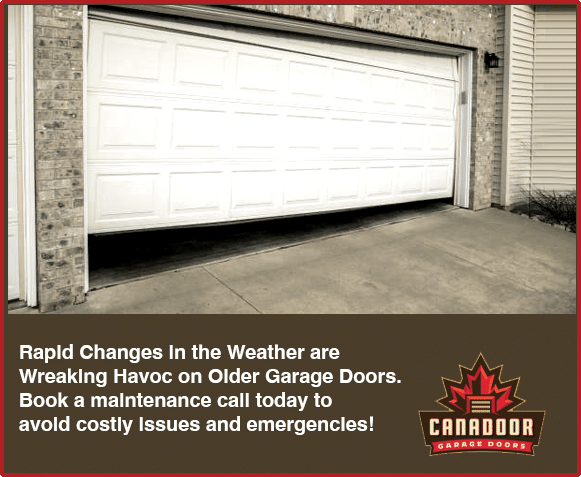
Most residential garage doors need a professional service once a year, plus a handful of quick checks you do yourself in between. The working schedule is: a two minute safety test every month, a balance test every three months, lubrication every three to six months (before winter is the important one in Ontario), hardware tightening and seal inspection twice a year, and a full professional tune-up annually. If your garage is the main entry to your home and the door cycles more than six or eight times a day, move the professional service to every six months. Commercial doors need quarterly service or more. Keeping to that schedule is what separates routine upkeep from unplanned garage door repair, and it matters most for the parts under tension: garage door spring and cable repair is the most common emergency call in this trade, and the one job no homeowner should ever attempt.
Key takeaways
- Annual professional service is the baseline for a normal residential door. High-use doors and commercial doors need it more often.
- Monthly safety test is the one task never to skip. It takes two minutes and it is the check that prevents a door closing on a child, a pet, or a vehicle.
- Ontario winters compress the schedule. Freeze-thaw cycles, road salt, and thickened grease mean the fall lubrication and seal check matter more here than in milder climates.
- Cycles matter more than years. A door opened eight times a day ages roughly four times faster than one opened twice a day, so base your interval on use, not the calendar.
- Two things are never DIY: anything involving the torsion springs and anything involving the lift cables. Both store enough energy to cause serious injury.
- Most emergency calls are preventable. The failures that strand people are usually the end point of a wear pattern that a tune-up would have caught months earlier.
The 8-point Ontario garage door maintenance schedule at a glance
| # | Task | How often | Do it yourself? |
|---|---|---|---|
| 1 | Look and listen check | Every month | Yes |
| 2 | Safety reverse test, contact and photo eyes | Every month | Yes |
| 3 | Balance test | Every 3 months | Yes |
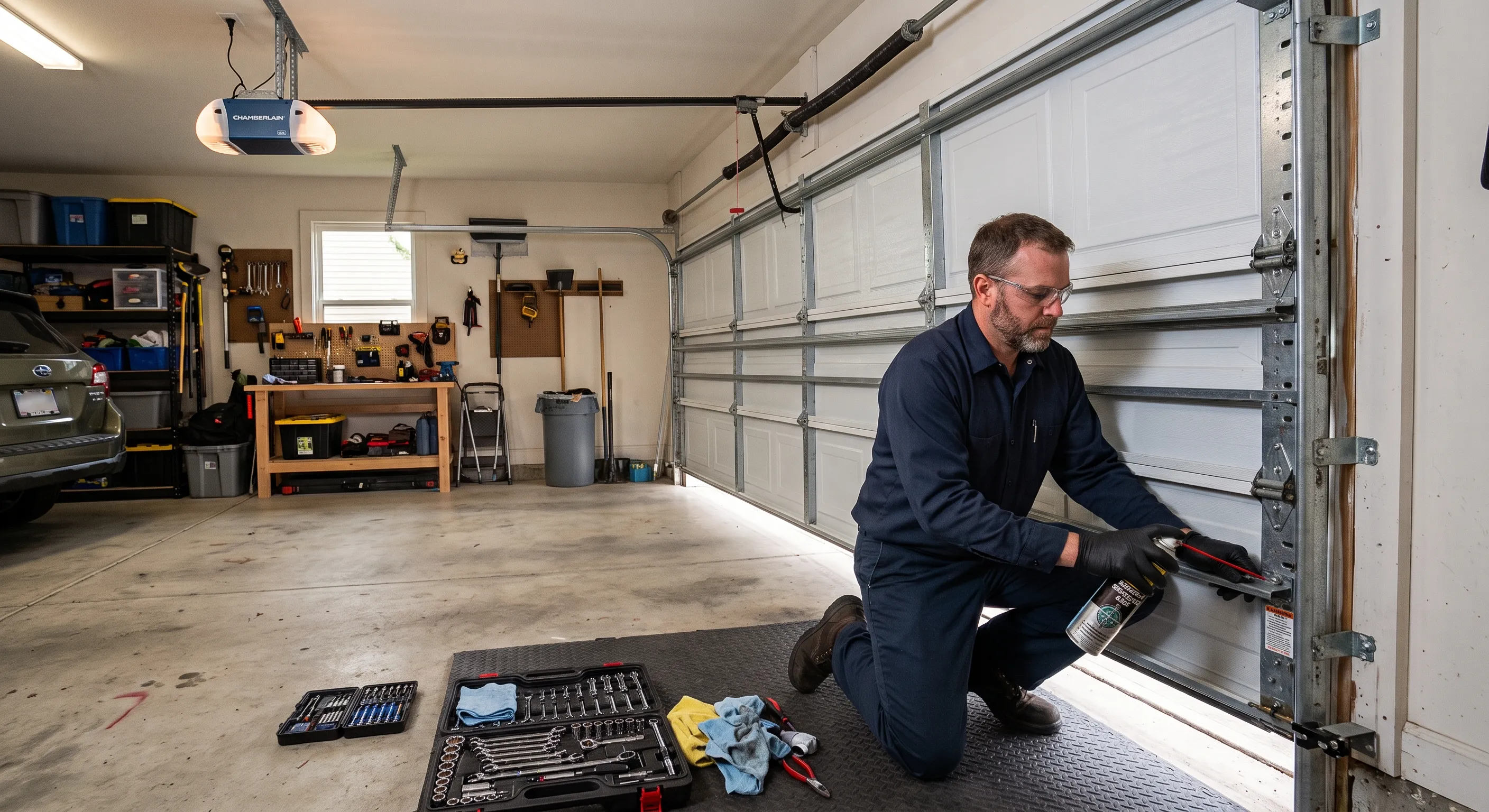
| 4 | Lubricate hinges, rollers, springs, rail | Every 3 to 6 months, always before winter | Yes |
| 5 | Tighten hinges and track bolts | Every 6 months | Yes, never the bottom brackets |
| 6 | Inspect bottom seal and weatherstripping | Every 6 months, fall is the priority | Yes |
| 7 | Wash the door and check the finish | Every 6 months, spring is the priority | Yes |
| 8 | Professional tune-up | Once a year, twice if high use | No |
1. Look and listen: every month
Do a two minute visual and sound check once a month. Stand inside the garage, run the door through one full open and close cycle, and pay attention rather than walking away.
You are listening for a change from normal: a new grinding, popping, or scraping sound, or a door that hesitates partway. You are looking for a door that runs crooked, cables that look loose or frayed, and rollers that visibly wobble in their tracks. A door that has started to jerk or shudder mid travel usually has a roller or track problem developing.
Rollers are the clearest example of why this monthly look matters, because they wear out on a schedule you can predict once you know what to watch for. See How Often Should Garage Door Rollers Be Replaced? 7 Signs Yours Are Worn Out for the full wear pattern.
Nothing here requires tools. The value is in catching the change early, because almost every expensive failure announces itself first as a noise.
Call a pro if: you see a gap or separation in a spring, a frayed cable, or the door runs visibly out of level. Stop using the door and book service.
Why does my garage door sound different than it used to?
New noise is the earliest and most reliable warning a garage door gives. Squealing usually points to dry rollers or hinges. Grinding often means a worn roller bearing or an opener gear starting to fail. A single loud bang, sometimes mistaken for a gunshot, is almost always a torsion spring breaking. Our guide to what garage door squeaks, grinding, and banging usually mean breaks down each sound and its likely cause.
2. Test the safety reverse: every month
Test both safety systems monthly. This is the single most important item on the list. Every opener built since 1993 has two independent reversal systems, and both can fail silently.
Test one, the contact reversal: lay a piece of 2×4 flat on the floor in the middle of the doorway and close the door. When it touches the wood, it should stop and reverse immediately. Test two, the photo eyes: start the door closing, then wave a broom handle through the beam near the floor. The door should reverse at once.
If either test fails, do not compensate by adjusting the opener’s force or travel limits. That hides the fault instead of fixing it, and it disables the protection you are testing for.
Call a pro if: either test fails, or the door reverses for no reason on a clear path. Misaligned or failing photo eyes are one of the more common service calls, and our post on fixing garage door sensor alignment covers what you can check yourself first.
How often should you test your garage door auto-reverse?
Once a month, every month, is the standard every major opener manufacturer prints in its owner’s manual, and it applies for the entire life of the opener. The full routine, including the checks most homeowners miss, is set out in How Often Should You Test Your Garage Door’s Auto-Reverse? 6 Safety Checks to Do Every Month.
3. Check the door balance: every three months
A balanced door should hold its own weight anywhere you leave it. Testing this every three months tells you whether the springs are still doing their job, which is the difference between a healthy door and one quietly destroying its opener.
Start with the door fully closed, then pull the emergency release cord to disconnect the opener. Lift the door by hand to about waist height and let go. It should stay put, or drift very slightly. If it slams down or springs upward, the spring tension is wrong. Reconnect the opener when you are done.
The order matters: always disconnect with the door closed. Pulling the release on a raised door can let it fall.
Call a pro if: the door will not stay put, or feels heavy to lift. An unbalanced door means the opener is hauling weight the springs should be carrying, which shortens the opener’s life considerably. Spring adjustment is not a DIY job, for reasons covered in why garage door springs are so dangerous.
Why won’t my garage door stay open halfway?
A door that drops when you release it has lost spring tension, either from a broken spring or from springs that have fatigued past their cycle rating. Standard torsion springs are typically rated around 10,000 cycles, which is roughly seven to ten years for an average household. See how often garage door springs should be replaced for the full lifespan picture.
4. Lubricate the moving parts: every three to six months
Lubricate the hinges, rollers, springs, bearing plates, and opener rail every three to six months, and always once before winter. This is the highest return maintenance task a homeowner can do, and the one most often done wrong.
Use a garage door specific lubricant or white lithium grease. Do not use WD-40: it is a solvent that strips existing grease rather than replacing it. Do not grease the tracks either. Rollers are meant to roll, not slide, and lubricant in the track just collects grit.
In Ontario the timing matters as much as the frequency. Cold thickens whatever is on the moving parts, and a door heading into January on dry hinges works harder in exactly the conditions that expose weakness. If you do it only twice a year, do it in October and April.
Call a pro if: parts still bind or squeal after lubrication. That points to wear, not friction.
How often should you lubricate a garage door in a cold climate?
Every three months is the safe interval for an Ontario door, versus six months in a milder climate, because freeze-thaw cycling and road salt shorten the life of any lubricant film. Our step by step guide to lubricating a garage door covers which parts to hit and which to leave alone. For the cold weather timing, which follows its own rules here, read How Often Should You Lubricate a Garage Door in Winter? A Seasonal Ontario Guide.
5. Tighten the hardware: twice a year
Check and snug the roller brackets, hinges, and track bolts every six months. An average door goes through more than a thousand cycles a year, and that vibration works fasteners loose.
Use a socket wrench and go around the door checking hinge bolts and track mounting brackets. Snug is the goal. Overtightening strips the sheet metal and creates a worse problem than the loose bolt did.
There is one exception, and it is important: leave the bottom brackets alone. The bottom bracket on each side is attached to the lift cable under full spring tension, and removing or loosening those bolts is one of the most common causes of serious injury in this trade.
Call a pro if: bolt holes are stripped, brackets are bent, or a bracket has pulled away from the door section.
Why do garage door bolts keep coming loose?
Because the door is a large vibrating assembly cycling repeatedly, and the sections flex slightly every time it moves through the curve of the track. Loose hardware is normal wear rather than a defect. It becomes a problem when a loose hinge lets a section shift far enough to bind, which is a frequent precursor to a roller coming off the track.
6. Inspect the weather seals: twice a year
Check the bottom seal and the perimeter weatherstripping every six months, with the fall check being the one that counts. These are the parts that decide whether your garage stays dry and whether the door freezes to the slab in February.
Look at the bottom astragal for cracks, hardening, tears, and flat spots. Squeeze it. Rubber that has gone stiff and no longer springs back has stopped sealing. Then check the perimeter stop moulding for gaps you can see daylight through, and clear any ice, gravel, or debris out of the channel the seal sits in.
In Ontario, bottom seals typically last two to five years, which is far shorter than most homeowners expect. Freeze-thaw is the reason: the seal gets wet, freezes to the concrete, then tears slightly every time the door lifts.
Call a pro if: the retainer holding the seal is bent or pulling away, or if the gap is caused by the door itself sitting unevenly rather than by a worn seal.
How often should garage door weather seals be replaced in Ontario?
Every two to five years for the bottom seal, and roughly every five to ten for the perimeter weatherstripping, though salt exposure and direct sun shorten both. If you are seeing daylight or water at the bottom of a closed door, see what causes a gap between the garage door and floor and our weatherstripping guide. A door that freezes shut is usually a seal problem first, as covered in why your garage door freezes shut in winter.
7. Wash the door and check the finish: twice a year
Wash the exterior twice a year, in spring and fall. This is cosmetic right up until it is not.
Use mild soap and water, rinse thoroughly, and pay attention to the bottom section. Road salt collects there, and on a steel door any scratch or chip in the finish that reaches bare metal becomes a rust site. Spring washing exists to get the winter’s salt off before it does that work.
While you are there, check the bottom section for dents and for any spot where the paint has bubbled, which usually means rust is already working underneath.
Call a pro if: rust has perforated a section, or a dent has creased the panel. At that point the question is repair versus replacement, not maintenance. See when to fix versus when to replace your garage door.
How do you protect a garage door from road salt in Ontario?
Rinse the bottom section every spring, touch up chips in the finish before they rust, and keep the area in front of the door clear of packed salted snow so the door is not sitting in brine every time it closes. Wood doors need more than this, as covered in our wood garage door maintenance tips.
8. Book a professional tune-up: once a year
A residential garage door needs professional service once a year. Make it twice a year if the garage is your main entry, if the door cycles more than about eight times a day, or if it is more than fifteen years old. Commercial and industrial doors need quarterly service at minimum, and high cycle doors more often than that.
A proper tune-up is not a lubrication visit. A technician measures and adjusts spring tension, checks the cables and drums, tests and adjusts the force and travel limits on garage door openers, verifies both safety reversal systems, inspects rollers and bearings for play, checks the track alignment, and tells you what is close to end of life so you can plan for it rather than react to it. That last item covers the body of the door too, so a section that has started to rust through or crack gets flagged for garage door panel repair and replacement while it is still one panel rather than four.
That last part is the real value. Springs, rollers, and openers all fail on a predictable arc, and the difference between a scheduled replacement and an emergency call is usually just whether someone looked.
Call a pro if: it has been more than a year, or you cannot remember the last time. Both count as overdue. Book a service appointment here.
How much does an annual garage door tune-up cost in Ontario?
A standard residential tune-up is priced in the low hundreds of dollars, and typically less than a fifth of what a single emergency spring replacement plus after hours call-out costs. Parts are extra if something needs replacing. Worth reading alongside why garage door maintenance is essential and how long a garage door should last in Ontario.
What you can do yourself, and what needs a technician
| Task | DIY safe | Call a technician | Why |
|---|---|---|---|
| Monthly look and listen check | Yes | No | Observation only, no tools |
| Monthly safety reverse test | Yes | Only if it fails | Simple test, but a failure means the safety system needs service |
| Quarterly balance test | Yes | If the door will not hold | Testing is safe, adjusting the springs is not |
| Lubricating hinges, rollers, rail | Yes | No | Basic, as long as you use the right product |
| Tightening hinges and track bolts | Yes | If holes are stripped | Bottom brackets excepted, always |
| Replacing the bottom weather seal | Usually | On sectional doors with a damaged retainer | Retainer work can require removing the bottom section |
| Adjusting spring tension | Never | Always | Torsion springs store enough energy to cause serious or fatal injury |
| Replacing or adjusting cables | Never | Always | Cables are under full spring tension |
| Anything involving the bottom bracket | Never | Always | Directly attached to a cable under tension |
| Adjusting opener force or travel limits | No | Yes | Set incorrectly, this defeats the safety reversal system |
| Replacing rollers, hinges, or sections | No | Yes | Requires releasing tension or partial disassembly |
For the difference between a certified door technician and a general handyman, see garage door technician versus handyman service. Technician certification standards in this country are set out by the Canadian Door Institute, and the safety and testing standards openers are built to come from the Door and Access Systems Manufacturers Association.
The short answer, and what to do next
Once a year with a technician, plus a two minute safety test every month and lubrication before winter. That schedule costs very little and prevents most of the failures that leave people stranded in their driveway on a cold morning. Skipping it does not save money, it just moves the spending to an emergency call.
If you are not sure when your door was last properly serviced, it is overdue. Canadoor Garage Doors has certified technicians across, and a scheduled tune-up now is a great deal cheaper than a broken spring in January.
Book your annual garage door tune-up, or request a free quote if your door is already showing symptoms. Same day service is available for doors that have stopped working.
Related reading: our annual garage door maintenance checklist for the task by task walkthrough, the spring maintenance checklist for Ontario homeowners, and why winter maintenance inspections matter.
Frequently asked questions
2. My door works fine. Is a tune-up really necessary?
"Working fine" and "not about to fail" are different things. A door with a fatigued spring or a worn roller bearing works normally right up until it does not, usually at the least convenient moment. The point of an annual visit is to find the parts that are close to the end and replace them on your schedule rather than theirs.
3. What is the most common thing that actually breaks?
Torsion springs, by a wide margin, followed by rollers and opener gear assemblies. Springs are wear items with a defined cycle life, so their failure is a matter of when rather than whether.
4. Why does my garage door only act up when it is cold?
Cold does three things at once: it thickens the grease on every moving part, it contracts the metal so tolerances tighten, and it stiffens the bottom seal so the door has to break itself free of the slab. A door with a marginal spring or a struggling opener has no reserve left to handle that, so it fails in January rather than July. See why your garage door struggles in winter.
5. My remote worked yesterday and does not today. Is that a service issue?
Usually not, and it is worth ruling out the cheap causes first. Start with the remote battery, then check whether the wall button still works. If the wall button works and the remote does not, it is the remote or its programming. If neither works, check that the opener has power and that the lock feature has not been switched on accidentally. Intermittent faults like this are the kind of small item worth logging on a household maintenance plan, and CMHC publishes seasonal maintenance guidance for Canadian homeowners that covers how to keep track of them.
6. How often should commercial doors be serviced?
Quarterly at minimum, and monthly for high cycle doors on loading docks or in busy shops. Commercial doors are rated in cycles, and a dock door can go through more cycles in a month than a residential door sees in a year. See why preventive maintenance matters for commercial garage doors.
7. Should I repair this door or replace it?
The rough rule of thumb: if the repair costs a meaningful fraction of a new door and the door is past fifteen years or has multiple failing systems, replacement usually wins. If it is one failed component on an otherwise sound door, repair it. Rusted through or cracked sections tend to push the decision toward replacement, because the structure itself is the problem. Full breakdown in when to fix versus when to replace.
8. Can I do the maintenance myself and skip the professional visit?
You can do a real share of it, and the monthly and quarterly items in this guide are genuinely worth doing. What you cannot do safely is the spring and cable work, and those are the systems that carry the risk. Think of the homeowner tasks as keeping the door healthy between visits rather than as a substitute for them. Where a repair touches the structure or the wiring of an attached garage, provincial rules can also apply, and Ontario is the place to check what needs a permit or a licensed trade.
9. How long should my garage door and opener actually last?
A well maintained steel door commonly lasts twenty to thirty years, with springs, rollers, and seals replaced along the way as wear items. Openers generally run ten to fifteen years. Maintenance mostly determines where you land inside those ranges. More detail in how long should garage door openers last.
10. What does a tune-up cost, and is it worth it?
A residential tune-up runs in the low hundreds, and a single emergency spring replacement with an after hours call-out typically costs several times that. The economics are not close, and that is before counting the opener wear an unbalanced door causes in the meantime.